



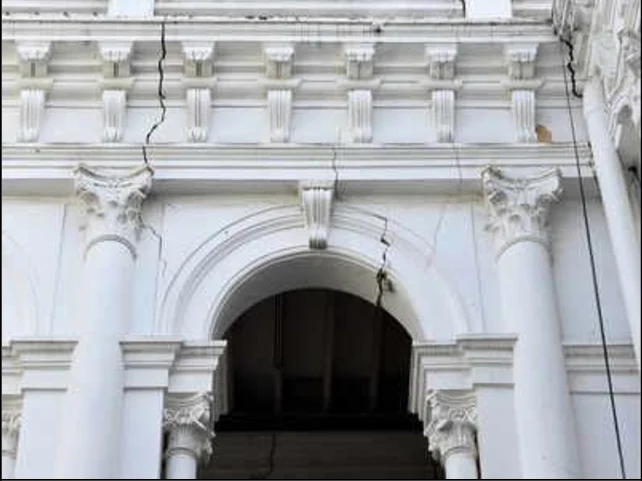
Historic buildings are more than structures. They are part of the identity of a place, the memory of its communities, and the physical record of craftsmanship, materials and construction methods that cannot simply be replaced. In the UK, where so much of the built environment is tied to local history, the appearance of cracks in walls in a heritage property is never just a maintenance issue. It is a matter of conservation, responsibility and technical judgement. In some cases, cracks in walls may also be linked to subsidence, but the visible damage itself is often the first concern.
Old buildings do not respond well to aggressive or indiscriminate solutions. They require diagnosis before action, precision before force, and methods that respect the behaviour of traditional materials such as brick masonry, lime mortars, stonework and historic shallow foundations.
Understanding the meaning of visible damage
Many owners, surveyors and asset managers first become aware of a problem when visible damage appears: diagonal cracks in walls, separation around openings, distortion in floors, movement in bay windows, or local settlement affecting paths, steps and adjoining masonry. In heritage buildings, these symptoms may have more than one cause. They can be linked to seasonal moisture change in clay soils, leaking drains, weak fill materials, long-term consolidation, changes in loading over time, or, in some cases, subsidence. The visible crack is often only the surface expression of a hidden interaction between the ground and the structure.
For that reason, investigation is essential, particularly when cracks in walls are already visible. Before any solution is recommended, the priority should be to understand what is happening below the building and how that movement is affecting the structure above. A historic property deserves more than assumption. It deserves evidence. Non-destructive or minimally invasive assessment is often the most appropriate approach, allowing the building to be studied without unnecessary disruption to the fabric that needs to be preserved.
Why a careful response matters
Where ground-related movement is confirmed, the challenge is not only to stop progression, but to do so in a way that is proportionate to the building. Heavy excavation, vibration, noise and extensive demolition are often deeply undesirable in listed buildings, churches, period houses, boundary walls and other sensitive assets. In such cases, minimally invasive ground improvement techniques may offer a more suitable route.
This is especially relevant where cracks in walls have become progressive, but where the building fabric itself remains recoverable and deserving of conservation. The aim should not be to overpower the structure, but to stabilise the cause of movement with a method that is compatible with the building’s condition, context and significance. In this context, GEOSEC UK notes that heritage buildings require solutions that address the source of movement while limiting disruption to the historic fabric.
Looking beyond cosmetic repair
In heritage settings, every intervention must balance technical performance with conservation principles, especially where cracks in walls are already visible. From an engineering perspective, the ground may need densification, void filling or deeper load transfer. From a conservation perspective, the intervention should preserve original fabric, reduce physical intrusion, limit vibration and maintain the legibility of the building’s historic construction.
This is particularly important because historic structures often behave differently from modern ones. Their foundations may be shallower, more variable and less well documented. Their walls may have accommodated slight movement over decades or even centuries. Their materials may be more breathable, more deformable and more sensitive to concentrated stresses. A simplistic repair to visible cracks in walls without addressing the underlying cause can result in recurrence. If subsidence is present, cosmetic work alone may only hide the problem for a time.
For owners and professionals, this means looking beyond the cosmetic repair of cracks in walls. Crack stitching, repointing or local redecoration may be necessary at the right stage, but only after the mechanism of movement is understood and, where required, stabilised. Otherwise, the building is simply being asked to hide a problem it is still experiencing. True repair begins below ground.
Across the UK, many heritage and character buildings are facing increasing pressure from ageing infrastructure, wetter and drier seasonal cycles, drainage defects and long-term ground variability. As a result, cracks in walls and, in some cases, subsidence are likely to remain a significant concern for surveyors, insurers, estates, trusts and private owners alike.





Leave a comment